
10 HR Challenges Growing Businesses Face
Growth breaks HR quietly. The processes that worked at twenty people don’t fail loudly at eighty — they just get slower, more manual, and more dependent on the person who remembers how everything works. Here are the ten problems that show up most predictably, and what usually fixes them.
1. The employee record fragments
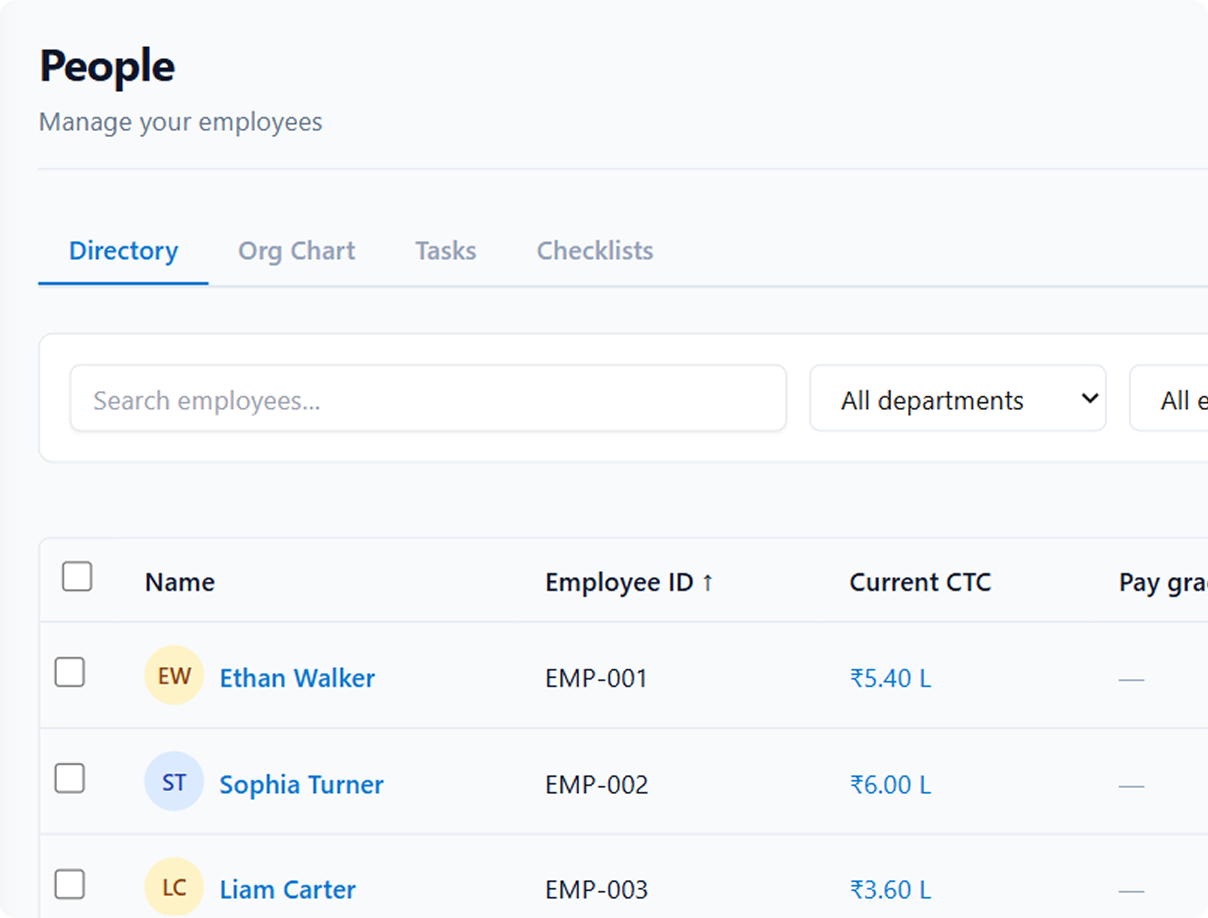
Personal details in one place, bank details in another, job history in someone’s memory. Every additional system multiplies the reconciliation. A single employee record stops the fragmentation before it compounds.
2. Onboarding becomes improvisation
At twenty people, someone shows the new hire around. At a hundred, that person is busy — and new joiners spend their first week hunting for accounts and paperwork. Structured onboarding workflows makes the experience repeatable rather than heroic.
3. Attendance stops being visible
Remote, hybrid, shifts, field teams — the moment your workforce stops sharing one office, informal awareness disappears. Attendance tracking and work mode replace the visibility that proximity used to provide.
4. Leave turns into a negotiation
Spreadsheet balances drift, policies get applied inconsistently, and managers approve without seeing who else is out. Consistent leave management with real balances removes most of the friction — and most of the resentment.
5. Payroll becomes a monthly risk event
More people, more variation: pro-rata joiners, unpaid leave, overtime, statutory thresholds. Manual payroll scales linearly with headcount, and so does the error rate.
6. Approvals live in chat
Decisions made in direct messages are decisions with no record. When someone asks who approved an exception six months later, the answer should not require scrolling. A single approvals inbox keeps the trail with the decision.
7. Performance conversations go annual
Growing teams postpone feedback until it’s a formal cycle, by which point it’s archaeology. Continuous goals and reviews keeps the conversation close to the work.
8. HR becomes a helpdesk
Payslip requests, leave balances, address changes, document copies. Each is thirty seconds; together they’re most of a role. Self-service hands those answers back to employees — the single highest-return change most HR teams can make.
9. Nobody can answer basic questions
How many people are in Engineering? What’s our attrition this quarter? What did overtime cost? When the data lives in five systems, every question becomes a small project. Cross-module reports that read across modules make them answerable.
10. Compliance drifts
Statutory obligations don’t scale with your team’s attention. PF, ESI, TDS and leave rules are unforgiving of the manual step someone skipped during a busy month — and audit trails matter precisely when you least expect to need them.
The pattern underneath
Nine of these ten are the same problem wearing different clothes: the employee record is not a single source of truth, so every process re-creates it. Fix that and most of the list resolves as a side effect.
That’s the argument for an integrated platform rather than more point tools. If you’re weighing it up, the People page explains how the modules share one record, pricing covers plans as you grow, and you can always book a demo to talk through where your own seams are.